
Aviassembly Cargo Types: Every Load, Value and Airport
Every Aviassembly cargo type with weight, volume, production airport and biome, plus how the market's reward and malus columns actually work.
Cargo is the core loop of Aviassembly, and the game gives you just enough information to make bad decisions. The mission board lists a weight and a volume; the cargo market lists what each airport produces; neither tells you which load will leave your aircraft wallowing at 40 metres over the sea.
This page is the reference: every commodity, its numbers, where it comes from and what it does to your build.
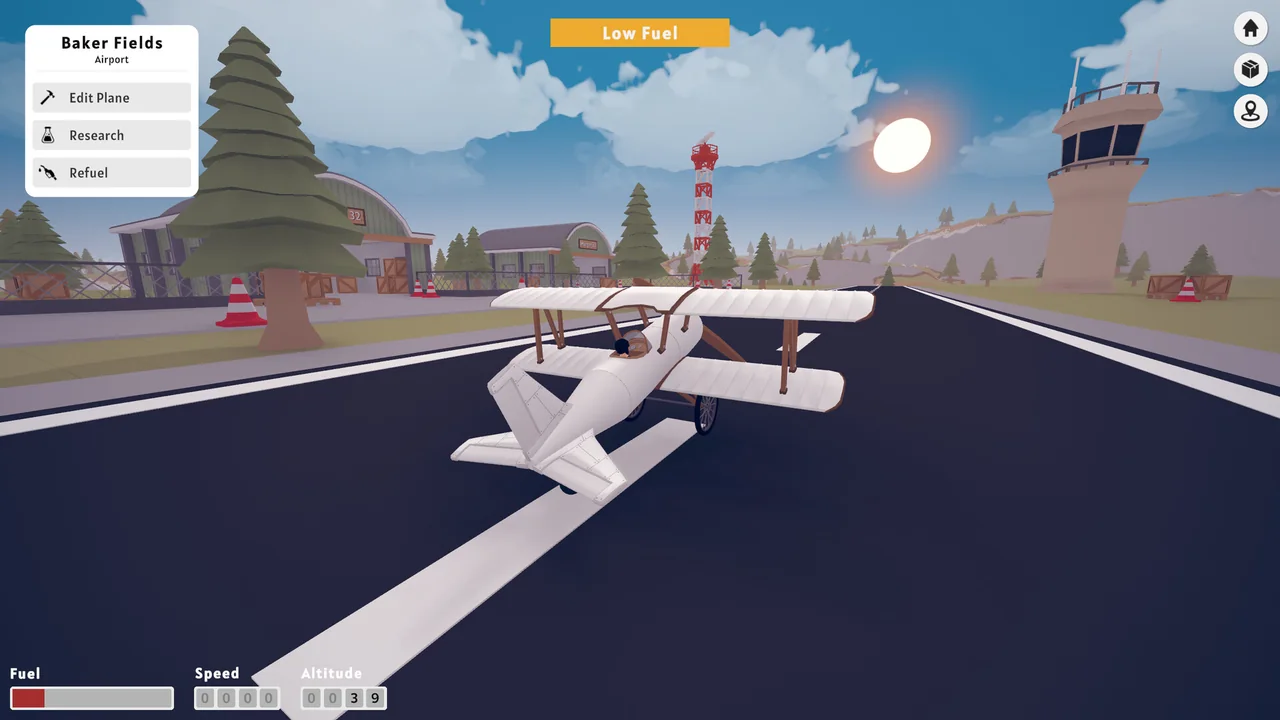
The full cargo table
Weight and space are per unit. "Timed" means the load starts a countdown when loaded; "fragile" means a hard landing destroys it.
Grasslands
| Commodity | Weight (kg) | Space (L) | Produced at | Notes |
|---|---|---|---|---|
| Medicine | 0.2 | 15 | The Hospital | Light, bulky, ideal first cargo |
| Small Battery | 0.1 | 10 | Wind Turbines | Easiest load in the game |
| Large Battery | 4 | 55 | Wind Turbines | Still light for its volume |
| Fruit | 0.2 | 20 | The Farm | 70 second timer |
| Tools | 0.6 | 25 | Lumbercamp | Good early earner |
| Lumber | 2.5 | 45 | Lumbercamp | Mid-weight, mid-volume |
| Wood Logs | 8 | 120 | Lumbercamp | The bulkiest early load |
Snow
| Commodity | Weight (kg) | Space (L) | Produced at | Notes |
|---|---|---|---|---|
| Ore | 4 | 50 | Mine | The starter snow cargo |
| Stone | 15 | 300 | Mine | Volume monster, heavy too |
| Glass | 1.5 | 10 | Factory | Fragile |
| Copper | 10 | 80 | Factory | Dense, pays well |
| Steel | 15 | 115 | Factory | The classic heavy load |
| Fish | 1 | 30 | Fishing Port | 55 second timer |
| Crab | 1 | 30 | Fishing Port | 45 second timer |
| Ice | 3 | 40 | Ice Packing Plant | Fragile |
Desert
| Commodity | Weight (kg) | Space (L) | Produced at | Notes |
|---|---|---|---|---|
| Titanium | 25 | 150 | Mine | Heaviest per unit in the desert |
| Lead | 25 | 250 | Mine | Heavy and bulky |
| Water | 1 | 10 | Water Treatment Plant | Light filler cargo |
| Chemicals | 1 | 40 | Advanced Research Station | 35 second timer |
| Syringes | 1 | 30 | Advanced Research Station | 30 second timer, fragile |
| Chips | 1 | 80 | Advanced Factory | Fragile |
| Radioactive Waste | 65 | 750 | Explosion Site | The finale load; weight was raised from 40 to 65 and space to 750 |
Earlier community tables list radioactive waste at 40 kg and 600 litres. A later balance pass moved it to 65 kg and 750 litres. If a mission board seems to demand more hold than your reference table says, this is why.
Reading the cargo market
The market panel has three columns that matter:
- Load room — the volume the cargo occupies, in litres. This is what your hold must fit.
- Weight — kilograms. This is what your wings and engines must lift.
- Malus — the penalty applied to the delivery, typically for fragile or timed cargo. A high malus is a warning that a rough landing or a slow route will cost you the payout.
A load can be light and enormous (wood logs, 8 kg and 120 L) or heavy and compact (steel, 15 kg and 115 L). Those two need completely different aircraft, which is why a single "best cargo plane" does not exist.
Biome economics
Grasslands pays the least per delivery but gives scrap on completion, and the cargo is light. It is where you learn.
Snow pays better, hands out scrap per mission, and its cargo splits neatly into light-and-bulky (stone) and heavy-and-compact (steel, copper). This is where a real cargo plane starts to pay for itself.
Desert pays the most and gives the most scrap, but the cargo is heavy across the board and the distances are long. Titanium and lead are the payloads that force you to build a genuine lifter.
The reward per kilometre is not the same as reward per minute. A short snow run that you can repeat three times an hour often beats a long desert haul that consumes a full tank.
Timed and fragile cargo
Timers start when the cargo is loaded, not when you take off, and loading another perishable resets the countdown. On a multi-stop route, load the timed item last.
Fragile cargo breaks on impact. The counter is not a stronger aircraft but a gentler one: more wing area, a slower approach, air brakes and a longer runway. Carrying spare volume so you can take extra units is cheaper than rebuilding the plane.
What to carry when you are unsure
Light, bulky cargo is almost always safe: medicine, batteries, water, tools. It fills the hold without pushing weight, so a modest aircraft can complete the mission and collect the scrap.
Avoid stone and radioactive waste until you have a plane built specifically for volume, and avoid titanium and lead until you have one built for weight. The weights guide→ explains how to size the aircraft for each.
FAQ
What is the best cargo to haul? Per unit of effort, steel and copper out of the snow are the best mid-game loads. Endgame, the desert pays more but demands a purpose-built aircraft.
Why can my plane carry 300 litres but not 300 kg? Volume and weight are independent. A 300 litre hold full of wood logs weighs 20 kg; full of stone it weighs 300 kg. Wings care about the second number.
Do cargo types unlock by biome? Yes. Each biome's airports produce a fixed set of commodities, and the desert's advanced factories only appear once you can reach them.
Official source: Steam store page ↗ and patch notes ↗; in-game values checked on version 1.0.
Related Guides
- Weights→ — sizing a plane around these numbers.
- Airports→ — production and demand by strip.
- Career Money→ — which loads to repeat.
- Cargo Truck achievement→ — the one delivery you make without flying.
Cargo values were cross-checked against the community cargo table guide ↗ and the in-game market; version changes come from the official announcements ↗. Store page: Steam ↗.