
Aviassembly Weights Guide: Mass, Volume and Takeoff
How weight and volume work in Aviassembly, why a 300 litre hold is not a 300 kg hold, and how to size wings and engines around a real payload.
Two numbers decide whether a mission is possible: the litres your hold can take and the kilograms your wings can lift. They are not the same number, they do not scale together, and the gap between them is where most failed deliveries happen.
This guide explains how to translate a cargo manifest into a build, and how to tell — before takeoff — whether the plane will actually climb.
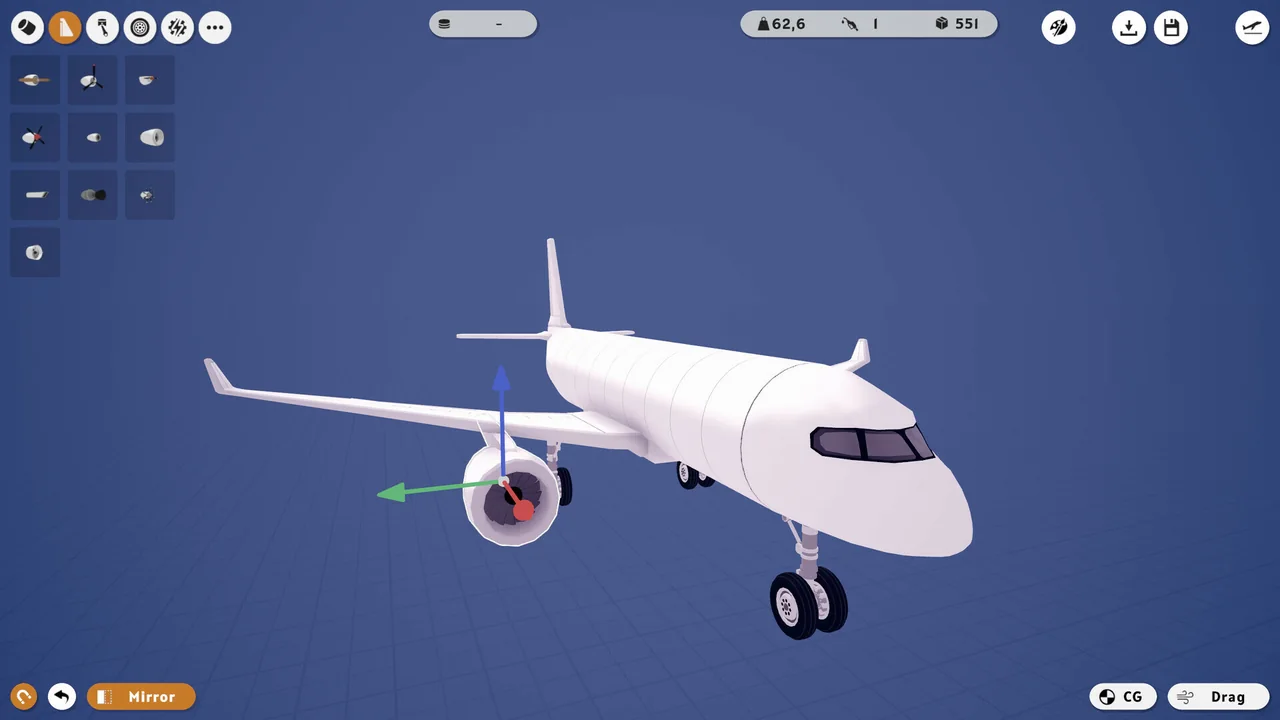
Volume is not weight
A cargo hold rated at 300 litres can hold 300 litres of anything. What that means in kilograms depends entirely on the commodity:
- Wood logs — 120 L for 8 kg. Filling a 300 L hold with logs adds about 20 kg.
- Stone — 300 L for 15 kg per unit, and a single unit fills the whole hold. That one unit weighs 15 kg.
- Steel — 115 L for 15 kg. Two units fill 230 L and weigh 30 kg.
- Lead — 250 L for 25 kg. One unit nearly fills a 300 L hold.
- Radioactive waste — 750 L for 65 kg. This is why the finale needs a genuinely enormous aircraft.
The pattern: cheap, bulky goods are light per litre; expensive industrial goods are heavy per litre. Your early missions are volume-limited. Your late missions are weight-limited.
Density is the build constraint
Think of every cargo as a density figure — kilograms per litre.
| Cargo | kg per litre | What it demands |
|---|---|---|
| Wood logs | 0.07 | Hold volume, not lift |
| Stone | 0.05 | Hold volume |
| Steel | 0.13 | Balanced |
| Copper | 0.125 | Balanced |
| Titanium | 0.17 | Wing area and engine power |
| Lead | 0.10 | Hold volume first |
| Radioactive waste | 0.087 | Enormous hold |
A plane built for wood logs is a flying box with modest wings. A plane built for titanium is a wing with engines, carrying a small dense block. Trying to make one aircraft do both is why players end up with a 40 metre wingspan that still cannot climb.
Sizing the wing
Wing area produces lift. More area lifts more weight, at the cost of drag and structural complexity. The practical method:
- Load the aircraft with the target cargo in the editor.
- Check the climb rate indicator or fly a test hop.
- If it cannot climb at a reasonable rate, add wing area or remove weight — in that order, because wings are cheaper than engines.
Wing strength is a separate limit. The displayed value multiplied by 100 is the speed at which the wing fails. A heavy cargo plane cruising slowly can use a weaker, lighter wing; a fast courier cannot.
Sizing the engine
Engines must overcome drag and gravity. A heavy aircraft needs thrust margin at takeoff, not just cruise power.
The useful rule: if the aircraft needs more than about two thirds of its available thrust to hold level flight at cruise, it has no margin for climb, and a short runway will kill it. Either add engine or reduce weight.
Capping thrust is still worth doing once you are airborne. A capped engine that produces exactly what you need burns less fuel than one running at full output through a throttle limit.
Fuel is weight too
Every tank you add is mass that does not pay for itself until you need the range. A plane carrying three full tanks on a 15 km hop is hauling two tanks of dead weight.
Plan fuel per route, not per aircraft. If your regular run is 25 km, fill for 35 km and leave the rest of the tank capacity empty. There is no penalty for flying light.
Takeoff distance is the hidden cost
Weight increases takeoff roll in a way that is easy to underestimate, and the destination strip is often shorter than the one you left.
For any heavy mission, check three things before accepting:
- Runway length at the origin, at full load.
- Runway length at the destination, at landing weight — which is lower if you burned fuel, but not if the strip is a 40 metre clearing.
- Obstacles on the approach. Trees and terrain do not appear on the mission board.
The island hopper in the best plane guide→ exists specifically for strips that fail these checks.
The 300 cargo problem
The community's recurring question is how to carry 300 units of cargo without building a blimp. The answer is that 300 litres is a volume target, not a weight target, and there are three ways to reach it:
- Two cockpits. The buffed early cockpits are efficient hold volume per kilogram.
- Wide fuselage. Stretch and widen faces in the editor rather than adding sections end to end.
- Cargo bays. Heavier per litre than cockpits, but cheaper in coins.
Then check the weight. A 300 L hold filled with stone is 300 L and 15 kg; filled with titanium it is 300 L and about 50 kg. Only one of those needs a new wing.
The best cargo plane is sized for the routes you actually fly. A 300 L aircraft that climbs well beats a 600 L aircraft that has to circle to gain altitude.
FAQ
Does weight affect landing? Yes. A heavy aircraft lands faster and needs more runway, and fragile cargo breaks more easily. Burning fuel before landing helps.
Is there a weight limit in the editor? No hard limit, only physics. The aircraft will simply fail to climb or fail to take off.
What does the malus column mean? It is the penalty applied to a delivery, usually for fragile or timed cargo. A high malus makes a rough landing or a slow route expensive.
Official source: Steam store page ↗ and patch notes ↗; in-game values checked on version 1.0.
Related Guides
- Cargo→ — every commodity's weight and volume.
- Parts→ — which components add lift or dead weight.
- Best Plane→ — builds sized for each cargo class.
- Airports→ — where the heavy cargo is produced.
Cargo figures were cross-checked against the community cargo tables ↗ and the in-game market; balance changes are listed in the official news ↗. Store page: Steam ↗.