
Aviassembly VTOL Build: Vertical Takeoff Without a Runway
How to build a working VTOL in Aviassembly: rotor placement, thrust control, the transition to forward flight and the mistakes that flip the aircraft.
Aviassembly has no dedicated VTOL part. What it has is rotators, engines with configurable thrust, and a physics model loose enough to let you point thrust downward and hover. That combination is enough to build an aircraft that lifts off from a clearing, a rooftop or a ship deck — which is exactly what the hidden airports ask for.
This guide covers the build, the controls and the part of VTOL flight that actually kills people: the transition from hover to forward flight.

What VTOL means in this game
A VTOL aircraft in Aviassembly is one where the thrust vector can point down. You achieve that in one of two ways:
- Rotating engine mounts. Engines attached to rotators that swing from vertical to horizontal. This is the classic tiltrotor layout and the one most Workshop VTOLs use.
- Separate lift and cruise systems. Dedicated vertical lift (rotors, or engines pointing straight down) plus a conventional forward engine. Simpler to fly, heavier to build.
The first is more elegant, the second is more forgiving. For a first attempt, build the second.
The build
Airframe. Keep it compact. A VTOL with a long fuselage is a pendulum, and pendulums are hard to hover. A wide, short body with the lift points spread out gives you roll stability for free.
Lift. Two to four engines or rotors mounted symmetrically. Symmetry is not optional: an aircraft with asymmetric lift will roll the moment it leaves the ground. Put the lift points as far outboard as the structure allows.
Thrust control. Right-click each lift engine and give it its own control group. You want to raise and lower collective thrust with one input, not four. If the engine supports reverse thrust, enable it — reverse is how you descend without cutting power entirely.
Rotation. If you are building a tiltrotor, mount the engines on rotators and use the rotation joint settings to clamp travel between vertical and horizontal. Update 10 added angle limits, rotation speed and automatic return to centre, which turns a floppy hinge into a controllable nacelle.
Landing gear. VTOLs land on their belly or on short legs. If the aircraft sits nose-down when stationary, the transition will be violent. Aim for a level attitude on the ground.
A VTOL with the battery pack at the tail will hover nose-up, and nose-up hover means you cannot see the ground. Put the heaviest part of the aircraft directly between the lift points.
Flying it
Takeoff. Spool the lift engines to hover thrust, then climb vertically to a safe height — at least 30 metres, more if there are trees. Do not attempt the transition near the ground.
Transition. Increase forward thrust gradually while reducing lift. The aircraft will sink as lift decreases; pitch the nose down slightly to trade altitude for speed. The first ten seconds are the dangerous part, because you have neither full lift nor full wing lift.
Cruise. Once the wing is carrying you, the lift engines are dead weight. Shut them down or feather them to save fuel.
Landing. Reverse the process: slow down, spool lift, descend vertically with a little forward speed so you can see where you are going. VTOL landings are easier with a slight nose-down attitude than with a perfect hover.
Common failure modes
Rolling on takeoff. Lift is asymmetric, or the centre of mass is off the centreline. Check that mirrored engines have identical thrust caps.
Pitching over in transition. Too little forward speed when lift is reduced. Keep the nose down and accept a small altitude loss.
Unable to stop the descent. Not enough thrust margin. A VTOL should hover at roughly 60–70% thrust, leaving room to climb; if it needs 100% to hover, it cannot land softly.
Fuel exhaustion during hover. Hovering is the most expensive thing you can do with fuel. Plan vertical segments in seconds, not minutes.
Where VTOL actually helps
The four ships added in Update 5 have decks rather than runways, and the smallest island strips are better suited to vertical landing than to a 40 metre rollout. VTOL also trivialises the "return to base" loop when you have landed somewhere with no runway at all.
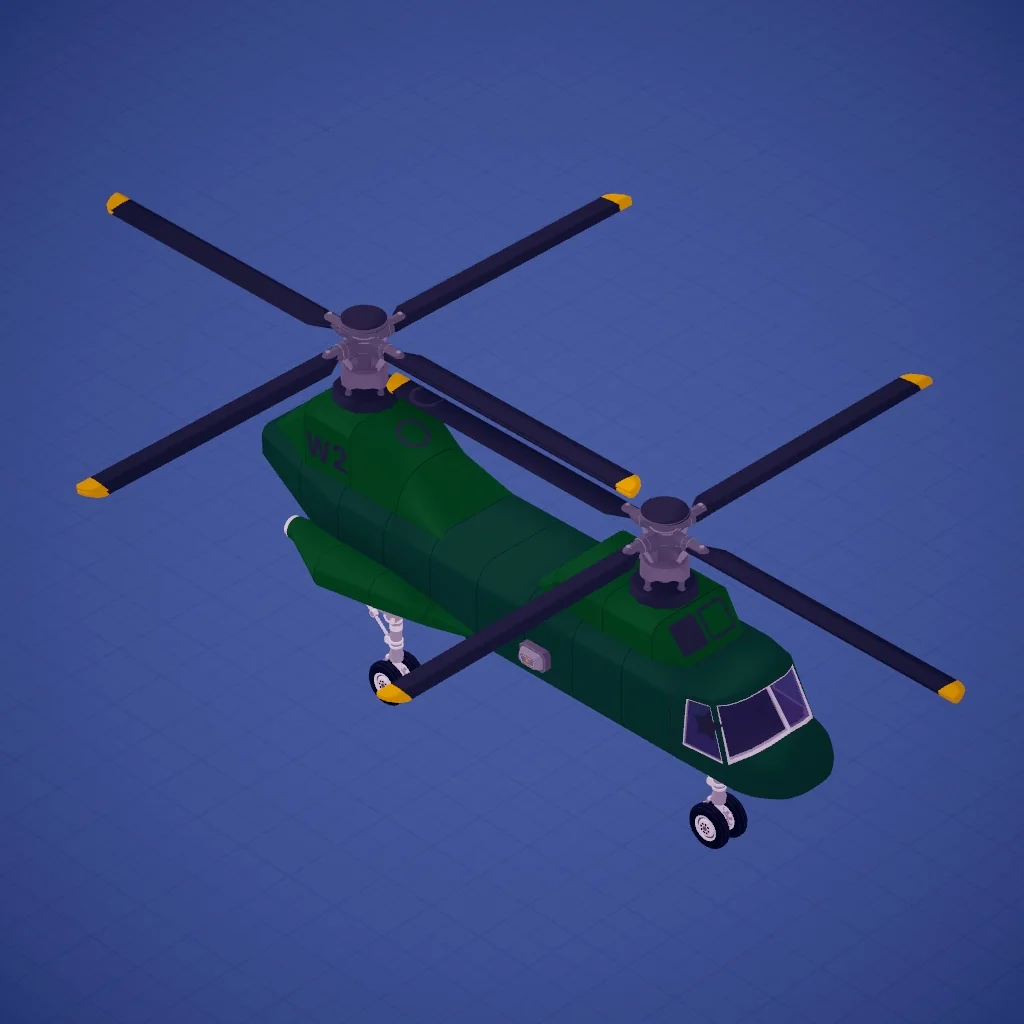
For pure ship work, a helicopter is the cheaper answer — see the helicopter guide→. For a fixed-wing aircraft that also happens to take off vertically, the tiltrotor is the better long-term investment.
The Workshop has several VTOL cargo designs, including one literally named VTOL Cargo. Load it, fly it, then open it in the editor and look at the rotator settings. Reverse-engineering one good hinge teaches more than a page of theory.
FAQ
Is there a VTOL part in Aviassembly? No. VTOL is an emergent build technique using rotators and thrust control, not a dedicated component.
Can a VTOL land on water? Only with pontoons. Hovering over water is fine; touching it without pontoons is not.
Why does my VTOL spin on takeoff? Almost always asymmetric thrust or an off-centre mass. Give each lift engine the same thrust cap and centre the heavy parts.
Official source: Steam store page ↗ and patch notes ↗; in-game values checked on version 1.0.
Related Guides
- Helicopter→ — the rotor branch in detail.
- Plane Designs→ — six layouts, including the rotor hybrid.
- Parts→ — rotators, decouplers and thrust settings.
- Controls→ — binding engines separately.
VTOL designs: Steam Workshop ↗. Rotator changes: Update 10 notes ↗. Store page: Steam ↗.